Brown Avenue: Ground Zero for a More Connected Downtown Maple Ridge
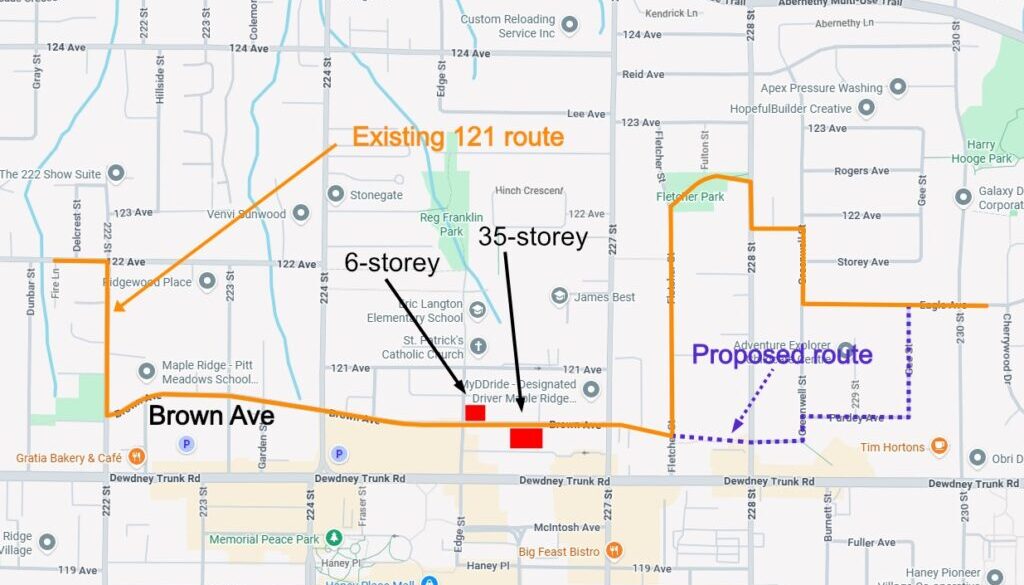
A major development proposal recently went through third reading at Maple Ridge City Council. The project features an unprecedented 35-storey tower with 252 strata units, by far the tallest residential building ever proposed downtown. And it’s not alone. Across the Brown Avenue area, mid-rise and high-rise projects are cropping up or heading to Council. Over the coming decades, thousands of new homes are expected in this neighbourhood.
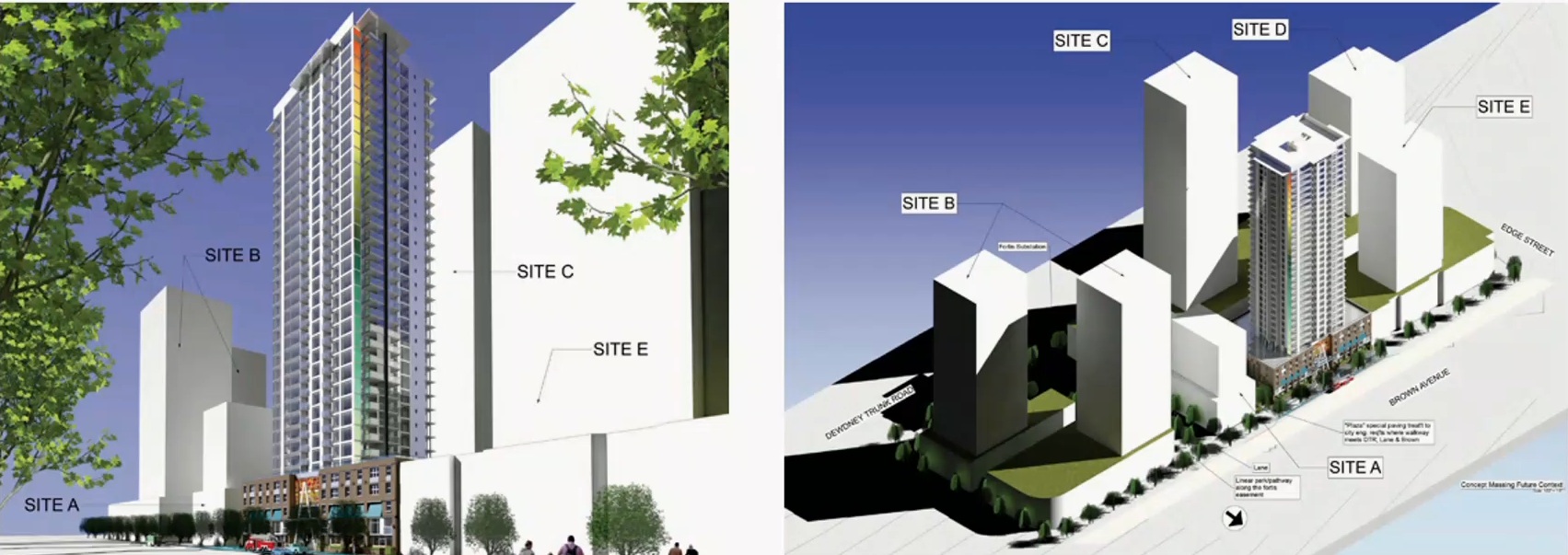
Artist’s rendition of the proposed 35-storey tower on Brown Avenue
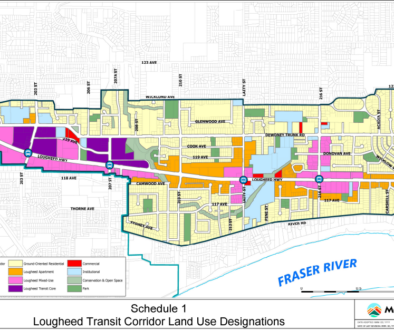
Sitting between Lougheed Highway and Dewdney Trunk Road, Brown Avenue and its surrounding blocks are at the heart of the city’s vision for a more compact, walkable, transit-supportive downtown. It is, in many ways, ground zero for Maple Ridge’s densification plans, including the broader Lougheed Transit Corridor.
But as the area gets denser, the buildings get taller and the population grows, an urgent question arises:
How will people move around safely, comfortably, and efficiently?
Why Brown Avenue Matters for Active Transportation
East-west travel options in Maple Ridge are limited, especially through downtown. Adding thousands of new residents will inevitably put pressure on already-busy roads. As density increases, pressure on local streets will grow. Encouraging more short and medium trips by walking, cycling, and scootering will be essential to maintaining mobility and reducing congestion.
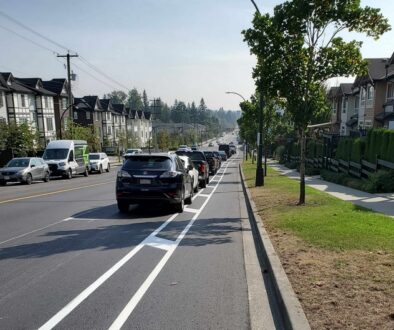
For years, Brown Avenue has been one of the very few safe, convenient east-west cycling routes downtown. Before recent construction, it was a calm street where people could ride comfortably. It also forms part of the 121 Bikeway, making it an essential link in our city’s active-transportation network.
As density rises, Brown Avenue won’t just be a local street. It will be a major people-moving corridor, one that needs the right design to support long-term mobility.
Proposed Infrastructure: A Multi-Use Path
As part of the project, the city is proposing a multi-use path (MUP) on the north side of Brown Avenue to be shared by people walking, cycling, scootering, and using mobility devices.
While MUPs can work well in parks or low-traffic areas, this design is completely inappropriate for what is becoming the densest area of Maple Ridge. With future volumes of people moving along Brown Avenue, mixing high-speed and low-speed travel creates avoidable risks and frustrations.
Why a MUP is the wrong fit downtown?
For people walking: Seniors with walkers, parents with strollers, children, and dog owners will not feel safe with fast-moving e-bikes and e-scooters approaching from both directions at up to 30 km/h. Even if collisions don’t happen, the experience becomes stressful.
For people cycling: Riders will constantly need to navigate around groups walking side by side or ride around unpredictable children and pets. What should be a reliable, efficient route becomes slow and tense.
These situations don’t reflect anyone acting irresponsibly. They are simply the natural result of trying to fit very different movement speeds and behaviours into a single narrow corridor. Everyone’s experience becomes more stressful, even when nothing goes wrong.
In short, in a high-traffic urban area, a multi-use path is a recipe for conflict.
Our Recommendation: Separated Space for Walking and Cycling
In our written submission and our presentation to Council at Public Hearing on November 18, HUB Cycling urged the City to take advantage of this unique “blank-canvas” moment and provide dedicated space for walking and dedicated space for cycling along Brown Avenue.
To create a welcoming, vibrant, safe Town Centre streetscape, one that encourages more people to walk and bike, the infrastructure must support them properly. This means:
- Protected bike lanes on both sides of the street, not just one mixed-use path
- Sidewalks designed for people walking, including seniors, children, and those using mobility aids
- Clear, predictable paths of travel, reducing stress and preventing conflicts
- Infrastructure built with future density in mind, not past conditions
Brown Avenue is being rezoned and redesigned right now. This is a once-in-a-generation, clean-slate opportunity to build the right infrastructure from day one.
If the City approves a MUP today, it becomes an anchor, a future barrier to improvement. We will inevitably hear:
“There isn’t enough road space for bike lanes.”
“It’s too expensive to change what’s already built.”
We can avoid this entirely by planning wisely now.
A Positive Step From Council
There is encouraging news. At a Council meeting following the Brown Avenue discussion, a motion was introduced directing staff to include a Town Centre Network Strategy in the 2026 work plan. This strategy would build on the Strategic Transportation Plan and outline new and improved active-transportation infrastructure for the downtown.
This is not the end of the conversation. Far from it. But it is a meaningful and constructive start.
We hope this direction gives the City’s engineering department the momentum it needs to take a long-term view of the Town Centre, ensuring that as thousands of people move into the area, they can travel safely and comfortably without relying on a car for every trip.
Brown Avenue is changing rapidly. With thoughtful design, it can become a model corridor for active transportation and a place where walking and cycling feel natural, safe, and enjoyable for all ages and abilities.
The opportunity is here. Let’s get it right.
Feedback is welcome by shooting us an email at mapleridge-pittmeadows@bikehub.ca.